

For export managers, CMOs, and CEOs expanding into international markets
Picture this. Your campaign in the UK just wrapped up beautifully. Green dashboards, solid pipeline, the team is happy. Someone in the boardroom says: “Germany is next. Big market. Let’s go.”
So you brief the AI, localise the assets, launch, and wait.
The traffic comes in. But nothing converts. Bounce rates climb. Your German sales contact calls, a little awkward, and says: “The messaging… it’s not quite right. It feels a bit fluffy.”
You’ve just hit one of the most common, and most avoidable, walls in international expansion.

The problem isn’t your product. It’s the playbook.
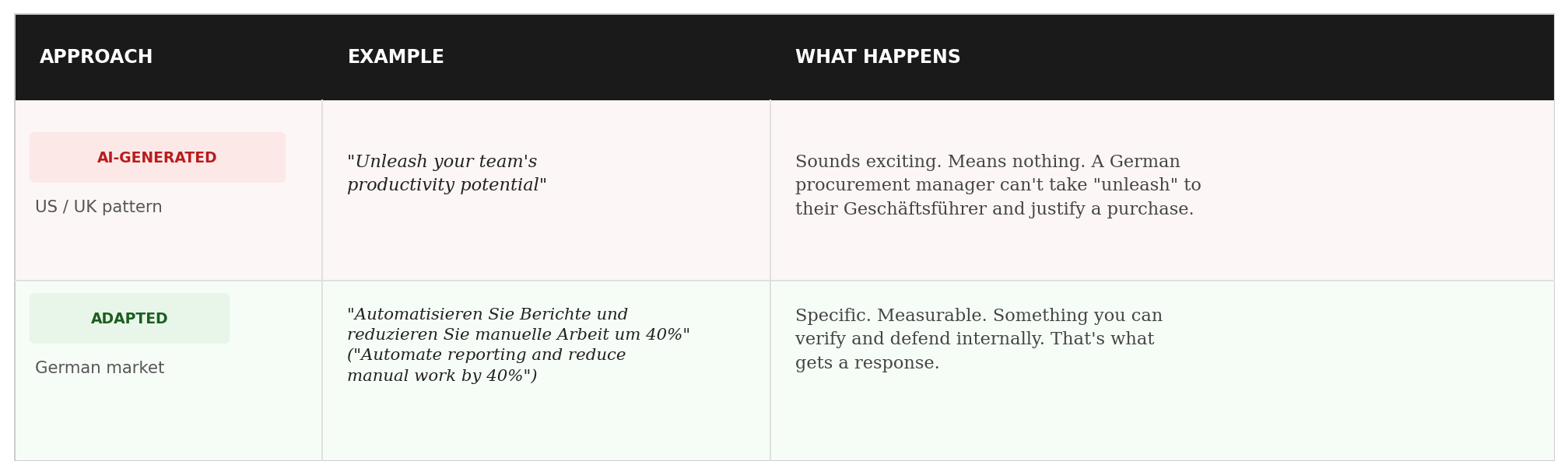
Here’s what happened under the hood. Your AI tools were trained mostly on English-language marketing data , US and UK campaigns, predominantly. That data reflects a communication style that works brilliantly in those markets: fast, emotional, aspirational. It gives you headlines like:
“Unleash your team’s potential”
“Revolutionise your workflow”
“Level up your business”
In London or Boston, these headlines land. They create energy. They move people.
In Munich or Hamburg? They raise an eyebrow. Then someone closes the tab.
German B2B buyers aren’t being difficult. They’re being German. And that means they want to know, before they do anything, whether you actually know what you’re talking about. Aspiration doesn’t answer that question. Evidence does.
What’s really going on here
There’s solid research behind this, and some of it is my own experience.
Forrester’s global research on B2B buying behaviour shows that purchase processes vary significantly across regions, and that Europe has the highest rate of stalled purchases of any market they studied. What triggers those stalls, and what gets buyers moving again, differs by region. That alone should give any export manager pause before copy-pasting a campaign from one market to the next.
Hofstede’s cultural dimensions research, one of the most replicated studies in cross-cultural business, places Germany high on uncertainty avoidance. In practice, that means German buyers manage risk by seeking information, verification, and process before committing to anything. A campaign that jumps straight to the emotional payoff skips every step that builds their confidence.
The Content Marketing Institute’s annual B2B benchmarks consistently list “aligning content with the buyer’s journey” among the top challenges for B2B marketers, year after year, roughly half cite it as an ongoing problem. That data is predominantly from North America, which makes it more telling, not less: if alignment is hard even in your home market, the gap only widens when you add cultural distance.
The rest comes from fifteen years of working with companies expanding into DACH markets. I’ve watched good products stall because the messaging was built for a different kind of buyer. The patterns are consistent enough that I no longer call it bad luck. This isn’t about Germans being hard to please. It’s about understanding that different markets run on different trust signals. And if your AI-generated content is built on the wrong training data, it will consistently produce the wrong signals.
Let me show you the gap
Here’s the same value proposition, two ways:
Example
What happens
One small practical thing while we’re here: German text is longer than English. Build that into your layouts from the start. It sounds minor until your beautifully designed CTA button says “Buchen Sie jetzt Ihre kostenlose Demo” and breaks across three lines.
What actually happened to one of my clients
A US SaaS company, sharing this with their permission, came to me after a painful Germany launch. Strong results in the UK and the Netherlands had made Germany look like the obvious next step. They used AI to generate the German content, set up personalised CTAs, and moved fast.
Traffic was fine. But conversions dropped by 76%.
When we dug into the feedback from their local sales team, the patterns were clear:
Headlines like “Reimagine your reporting” were evocative, but empty. Nothing a German buyer can act on.
Landing page copy like “Let’s make reporting effortless, together” were too informal, too casual for the market. It read as unprofessional.
CTAs saying “Book your demo now” was too pushy for a market where trust builds slowly and decisions involve multiple stakeholders.
We made three core changes. Native in-market marketers rewrote the copy around specific outcomes, compliance references, and certifications their buyers actually recognised: TÜV, ISO, DSGVO. Visuals shifted from Silicon Valley startup aesthetics to something that looked like the industrial, operational world their German buyers actually lived in. And the CTAs became invitations rather than demands: “Get the technical guide” and “See how it works in your industry.”
Within three weeks, conversions rebounded. Demo requests rose 40%. Same product, same goals, just finally speaking the right language. And I don’t mean German.
Five things to do before you launch in Germany
1. Trade inspiration for evidence Every aspirational claim needs a number behind it. “Reduce manual reporting time by 40%” will always outperform “streamline your workflow” in this market. If you don’t have the number yet, that’s the first thing to get.
2. Put compliance front and centre, not in the footer. DSGVO, ISO, TÜV, these aren’t nice-to-haves for German buyers. They are qualifying criteria. If you bury them at the bottom of the page, you’ve already lost a significant portion of your audience.
3. Rethink your CTAs German B2B sales cycles are longer and involve more people. “Book a demo now” signals that you don’t understand that. “Download the technical overview” or “See use cases in your industry” respects the process and gives buyers something useful at their stage.
4. Use native reviewers. Always. I cannot stress this enough. AI will not catch a tone mismatch or a phrase that reads as arrogant in German business culture. A native reviewer with real market experience is not a luxury. It’s the last line of defence before something embarrassing goes live.
5. Brief your AI on the market, not just the language If you’re using AI to generate or adapt content, your prompts need to explicitly encode German communication norms. Generic prompts produce generic output. Tell it to be evidence-led, formal, and specific. Tell it to avoid hype. Tell it what German buyers care about. You’ll get dramatically better results.
A quick word on DACH
If you’re expanding into Germany, Austria, and Switzerland together, know that these aren’t one market with a shared language, they’re three distinct contexts that happen to speak German.
Swiss B2B buyers tend to be even more formal, and often expect multilingual communication. Austrian business culture shares German precision but usually with a warmer interpersonal register. The frameworks in this article apply broadly across DACH, but don’t assume one campaign serves all three without any adjustment.
The bigger picture
AI is genuinely powerful for international expansion. The speed, the scale, the ability to produce and test content across multiple markets, that’s real. I’m not here to tell you to slow down.
But cultural intelligence isn’t something you can automate yet. It’s the layer that determines whether all that efficient output actually lands. And Germany, specifically, has a low tolerance for campaigns that skip it. They will tell you directly, without much cushioning that your messaging isn’t working.
Which, when you think about it, is actually useful. Germany is one of the best stress tests your international playbook will ever get. If you can make it work there, you’ve built something solid.
Before you launch: a quick checklist
Replace aspirational slogans with specific, measurable claims
Bring compliance, certifications, and security signals into the main messaging
Replace pushy CTAs with informative, low-pressure alternatives
Have a native reviewer check tone and credibility before anything goes live
Make sure your visuals reflect German B2B reality — not startup culture
Give your AI tools explicit instructions on German communication norms
If you’re covering DACH, treat each market individually
Sources: Hofstede Insights, cultural dimensions research, hofstede-insights.com/country-comparison-tool; Forrester Research, "Four Key Ways B2B Buying Varies Across Global Regions," Beth Caplow, April 2022, forrester.com; Content Marketing Institute, B2B Content Marketing Benchmarks, Budgets, and Trends: Outlook for 2025, Stephanie Stahl, October 2024, contentmarketinginstitute.com